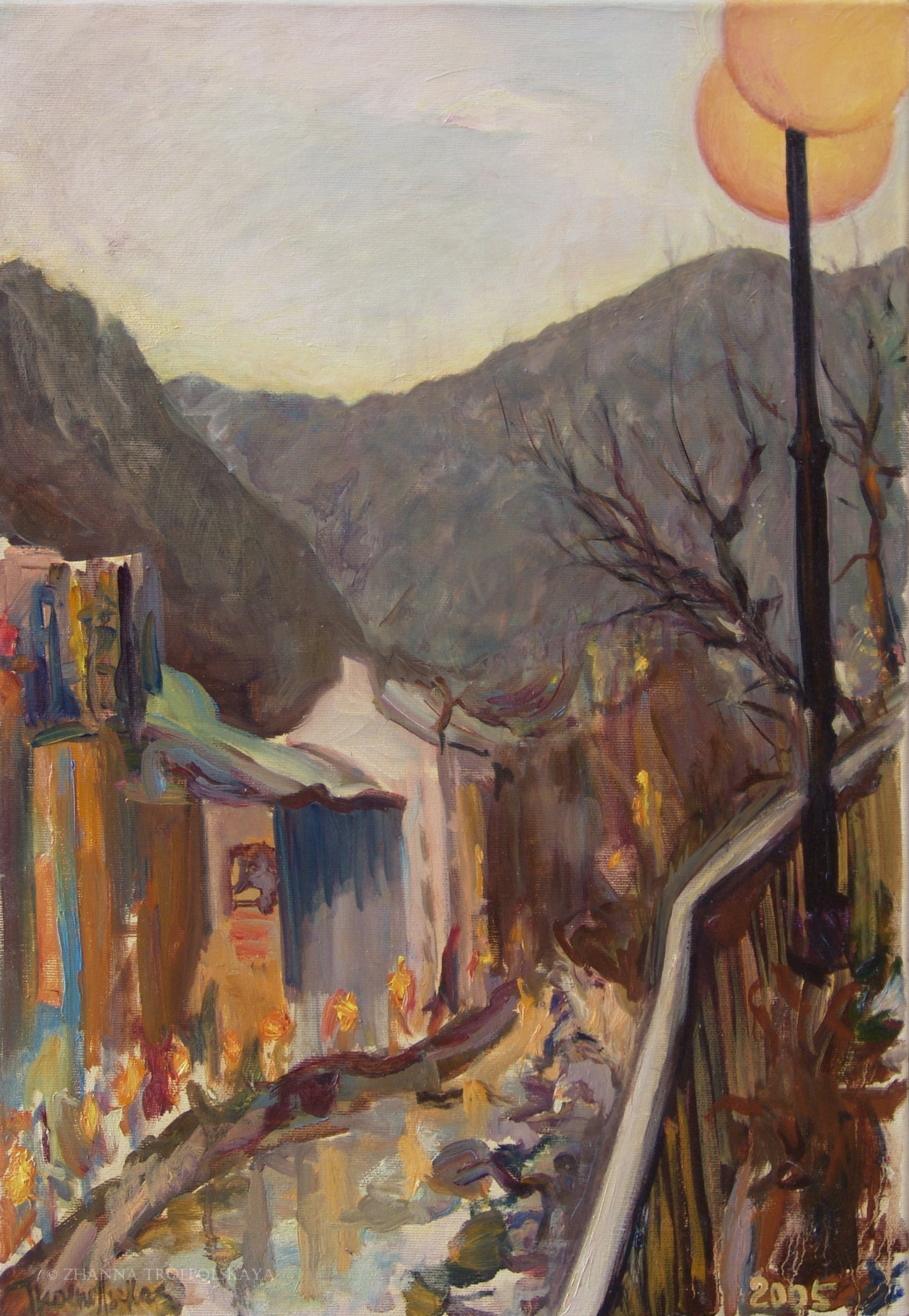
Place of creation: Escaldes-Engordany, Andorra
Date: 2005
Medium: oil on canvas
Dimensions: 38 × 55 cm (unframed)
Painted en plein air from the platform extending along the hotel façade above the river
The Story Behind the Painting
It was January in a tiny mountain principality. Visitors came for the skiing, the shops and the restaurants. In summer, once the snow had melted, the most celebrated views lay high in the mountains, sometimes hours away on foot. Down in the town, among concrete buildings, asphalt and grey slate, few thought to look for beauty.
The painter had often encountered surprise at her choice of subject. People would question what she had found worth painting in an ordinary street or an unremarkable corner of a town — sometimes before they had seen the painting itself.
She had spent time searching for a view that winter. Eventually she found one beside a hotel, where a short bridge crossed the mountain river. A terrace above the water overlooked the river winding between buildings towards the distant mountains. The hotel’s lamps stood in the foreground.
She came back with her paintbox, canvas and painting equipment as the January afternoon was drawing to a close.
The weight of everything was unmistakable on the walk through town. She was dressed too lightly for the cold, with no warmer clothes available, and the icy pavements made each step less certain. By the time she reached the hotel, she had felt every part of the journey.
But the light was already changing. She began setting up her easel and preparing her palette.
A security guard approached. This was private property, he told her, and painting was not allowed.
When he walked away, she went on squeezing paint onto her palette. The light was slipping away by the moment. There was no time to lose, and no real choice but to begin.
Once she was painting, the cold slipped out of her thoughts. Her body remained in the January air, on the same treacherous ground, but her attention was wholly taken up with the work. The light changed, the colours on the canvas changed, and the minutes passed almost unnoticed.
A tall, elegantly dressed gentleman approached. He was exceptionally courteous, asked where she came from and exchanged a few pleasant words with her. Then he wished her well and walked farther along the terrace, entering a separate chalet adjoining the hotel. The only way to reach it was through the hotel’s grounds.
She wondered whether he might be the owner.
The security guard had been watching from a distance. A few minutes later he returned. This time he said nothing about private property. Instead, he gently warned her to take care: the ground around her easel was dangerously icy.
Then he left her to paint.
The light was disappearing faster than she could work. At last there was too little left to continue. She put down her brushes, and the cold, which had been there all along, suddenly made itself felt again.
There was still the paintbox to pack, the canvas to carry, and the icy walk back through town.
The following evening she returned at much the same hour. The light was changing just as quickly, and she took up her brushes again.
Towards the end of the session, when it was nearly time to pack away her paints, the security guard approached once more. Knowing that she was a foreigner, he pointed to the study and said a single word:
“Beautiful.”
He did not linger. He walked away, leaving her to her work. Two years later, the hotel closed and was converted into residential apartments. The terrace above the river remained, as did the hotel’s name — in the title of the painting.