2017; oil on canvas; 46 × 46 cm (unframed)

Zhanna Troepolskaya’s Magenta Period brings together an intensely felt response to the beauty of life and the discipline of a rigorous classical artistic education. Its expressive freedom, emotional depth and heightened sense of colour invite comparison with a contemporary form of Neo-Romanticism. Yet the distinction of these paintings lies not in their adherence to a particular movement, but in the singular relationship between painterly precision and sensuous intensity.
Magenta is central to this relationship. In Troepolskaya’s paintings, it is neither a decorative flourish nor an assertion of colour for its own sake. Its presence can be vibrant and commanding, yet also extraordinarily delicate. Through subtle chromatic relationships and finely worked, translucent layers, colour acquires a luminosity that seems to emerge from within the painting. Its intensity is inseparable from its fragility — from the slightest transitions of warmth and coolness, density and transparency, light and shadow.
Against these richly nuanced grounds, the white and pink petals of her peonies retain a remarkable precision of form while remaining alive to the movement of light. Her classical training is present not as a restraint upon expression, but in the assurance with which form, colour and painterly gesture are held together. Even at their most emotionally charged, the paintings preserve a finely judged pictorial order.
There is a particular affinity between this chromatic world and the faded splendour of historic Venetian interiors. Deep purple and wine-red velvet, silk and brocade, aged mirrors, gilded frames and the shifting reflections of Murano glass evoke a richness shaped as much by time and light as by ornament. The magenta of Troepolskaya’s paintings enters into dialogue with these textures and tones, not by imitating their luxury, but by bringing a renewed sensitivity to their presence.
In such surroundings, the paintings bring a new vitality to the elegance of a bygone age. Their contemporary colour does not overwhelm the delicacy of an older world; rather, it brings its historic richness into a new and living relationship with light, space and feeling. The emotional intensity of the painting and the cultivated restraint of the interior meet in a sensuous refinement that is at once historical and unmistakably contemporary.
What emerges is a distinctive kind of Venetian elegance, in which the splendour of the past is neither merely preserved nor theatrically revived, but made newly perceptible. Through the fragile luminosity of colour and the living presence of the painted flowers, the stillness of the interior acquires an ensouled rhythm of living movement — as though the space itself were quietly awakening to the wonder of being alive.
2017; oil on canvas; 46 × 46 cm (unframed)
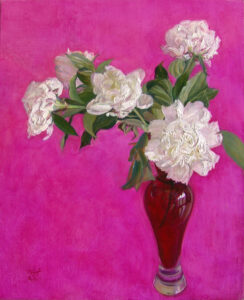
2015; oil on canvas; 50 × 61.5 cm (unframed)

2014; oil on canvas; 46 × 65 cm (unframed)

2013; oil on canvas; 60 × 60 cm (unframed)

2013; oil on canvas; 60 × 60 cm (unframed)

2013; oil on canvas; 38 × 46 cm (unframed)

2013; oil on canvas; 46 × 55 cm (unframed)

2013; oil on canvas; 41 × 46 cm (unframed)